Well the time finally comes at the end of summer for some of us who experience the four seasons to temporarily abandon our favorite activity and think about storing our kayaks and canoes.
Parks close, cold and ultimately snow and ice will be present and invite us for winter sports or other type of outdoor activities. And yes, it’s always possible to play outdoor even during those super cold winter months!
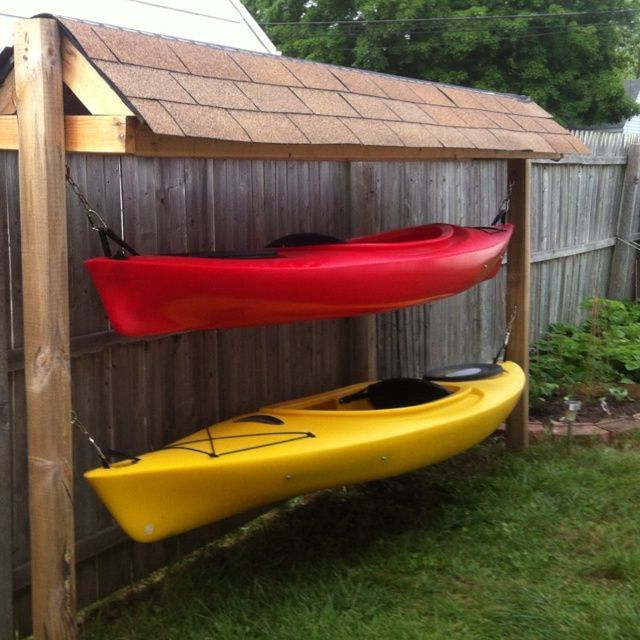
What Do We Do With Our Equipment?
You may think it’s easy to store your equipment and it does not require a lot of knowledge and experience.
However a little planned care for your kayaks or canoes and other related accessories can result in better and safer paddling when the season comes back.
It’s a fact of life everything gets old even your kayaks! Throughout the years, you can expect scratches, holes, real cracks (the kind that get you worried), faint painting. We’re not living in an ideal world so we need to plan maintenance care and storage at least once a year.
Your safety and pleasure on the water depends on it!
I discovered by experience using expensive outdoor equipment, that there are three steps not to be forgotten:
• Cleaning
• Repair and maintenance
• Adequate conditions for storage
Follow these three simple yet very effective principles for any of your gears (kayaking, scuba diving, camping, hiking…) and you’ll be able to enjoy safe and performing equipment during all your seasonal and favorite activities!
Cleaning Your Gear
We all agree that when you unpack your gear at spring time it feels much nicer to find cleaned boots, stoves, sleeping bags, tents and boats!
Boats and folding boats:
• Remove all lose components (straps, seats, hatch covers) and wash them with warm fresh water using a mild detergent (don’t use strong commercial products or bleach that will burn the fibers). Rinse well thoroughly afterwards. Don’t forget to wash also your personal flotation device!
• Remove salt water and sand from your kayak or canoe or diving gear (regulators): rinse the boats, and all the attached parts (deck cords, toogle handles and bulkheads), pedals, rudder or derive
• Use an eraser-type sponge if your kayak stays in the water during the entire season
• Try to check all the O rings for dirt and clean well the openings of your dry compartments.
• And most of all let all your gear dry properly –put your boats upside down and off the ground. Use a towell if necessary.
Paddles:
Paddles are very expensive, I keep all our paddles in a safe place in our basement during those long winter times.
If you have 2-piece paddles then store them in separate pieces. But before that, clean the joints both inside and outside with a small bottle brush (I’m using my old baby bottle brush!):
After this easy step I simply wash and rinse the paddle carefully and dry with a soft towel.
I do the same thing for my canoe’s wood paddles.
Drysuits, wetsuits and PFD’s
Before anything else wash them and dry them very carefully. Actually this is the same thing you should do after each use! Check all zips carefully during that process.
One thing for sure: Do not put your wet suits in a washing machine!
If you need to replenish the waterproof treatment on your PFD or dry suit then the best thing to do is to consult individual manufacturers for guidance.
Repair and Maintenance
Check every boat and every piece of equipment carefully to see if any repairs need to be done.
And don’t be lazy. If you see something wrong, just repair it now!
Adequate Conditions for Storage
You need to put your canoes or kayaks in a safe place. That is somewhere where they won’t get damaged.
If you leave them in the snow, then you might expect some damage to occur from freezing and expanding or your local wildlife!
The best thing to do is to store your canoe or kayak in a garage. If you don’t have a safe place like that, then simply store your boat outside, but well covered. Then you can cover it quite easily.

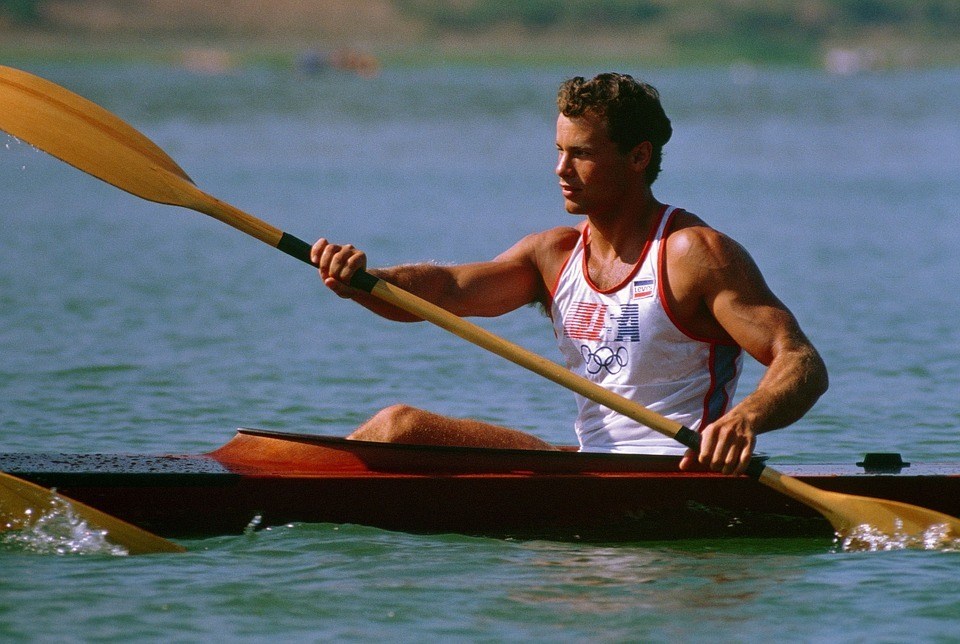 Any outdoor activity like kayaking, canoeing, hiking, biking among others, requires a few winning elements to be successful.
 Kayaking or canoeing equipment is evolving in ways that makes paddling more comfortable, more enjoyable and safer.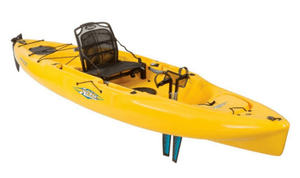
 Hobie Kayak- Mirage Brand
 Native Watercraft- Propel Brand
 A very important factor when it comes to stability for pedal kayaks is the hull size.
 This debate have gone on for a long time. The consensus that you find is a large dependency on the actual driver. Whether the driver has a stronger upper body or lower body can have a huge differences. There are cases of paddlers leaving pedalers in the dust and vice versa. Looking at it mechanically and from a design perspective considering the fact that pedal kayaks are less stable in the water and the fact that they must be wider to enhance stability, they are likely to be slower. They also feature rudders for steering purposes; these rudders increase their friction within the water thus decreasing the kayak’s speed by an average of 10%. Also the added width makes them heavier, making them slower in the water. The above reasons make them put a lot more pressure on the user resulting in earlier fatigue. These kayaks are usually used for recreational purposes such as fishing and touring and not racing.
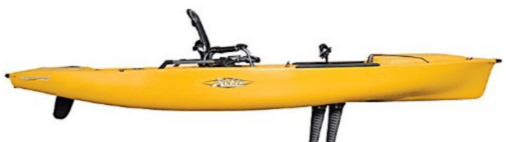 What makes the steering difficult on the pedal kayak compared to a paddle kayak is debatable, a rudder can only be so large at the bottom of the kayak and you can only dedicate so much effort to adjusting it. Also the effect of a paddle on the far side of a kayak is more pronounced in turning then in the centre bottom of the boat. With a paddle you can make sharp turns whereas with a pedal kayak and a rudder you may have to do some adjustments similar to what you would see on a boat. Not quite like the titanic trying to avoid an iceberg but the difference is pronounced!
 For the rotational pedals, the user is able to engage uninterrupted motion; meaning that the generated energy is not lost rather it is preserved. In rotational drive pedals, the pedals are an efficient means of the body transmitting power to the propeller with minimal energy loss.
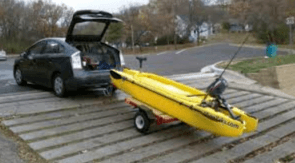 Getting a pedal driven kayak in the water can be hectic especially if you don’t have the man power to assist you. Their wide hull makes them heavier than the paddle kayaks.
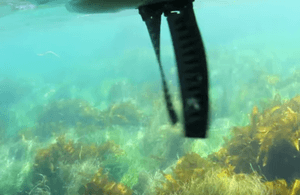 Kayaks have the ability to take you anywhere you want to go but for pedal kayaks, visiting some areas especially shallow water areas and areas with sea weeds can be problematic. The reason behind this limitation is that shallow waters make the propellers prone to obstruction from mud and obstacles underneath the water.
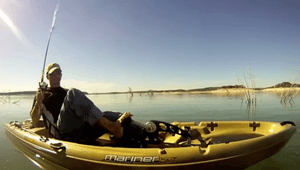 It’s often argued that pedal kayaks are the best when it comes to fishing since they only utilise your legs for motion which keeps your hands free to fish! This also allows the user to pedal and fish at the same time. Although both hands are free, at times you might find yourself with just one hand free and the other holding onto the kayak’s deck or leaning on it to keep balance. However, fishing with a Pedal Kayak is a little more fun than using the paddle kayak since you can move along while fishing in comfort unlike with the paddle kayak. The only limitation of the Pedal Kayak is that is doesn’t have the reverse capability thus going backwards can be a bit of a hassle. This issue is solved if you choose a rotational pedal kayak.
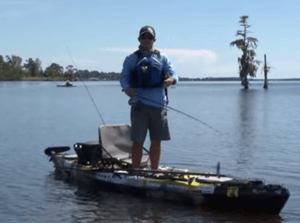 Standing up and fishing while in a pedal kayak can be achieved when you are sure that nothing will destabilize you. It is always advisable to remain seated while fishing however many kayaks advertise themselves as being great for stand up fishing. Although it’s argued that the Pedal Kayak is large enough to ensure stability even when standing, anything can cause you to lose balance and end up falling in the water.